Equity Education
Seminar with
JB Mahli
Main points takeaways from the seminar
1. Equality and Equity
EQUALITY
Everyone receives the same treatment
EQUITY
Fair access to opportunities, resources and power
2. Intention → Systemic Reality → Impact
INTENTION
→ SYSTEMIC REALITY
→ IMPACT
Good intentions alone do not guarantee equitable outcomes. Examine systems and the effects of our actions.
-
Educated Citizen
Intellectual development, Human and social development
Career development - Education should nurture academic knowledge, relationships, responsibility and preparation for life and work.
4. Approaches to Seeing
Distinguish what is observed from the meaning or value assigned to it.
OBSERVATION
Descriptive seeing
JUDGMENT
Interpretive seeing
5. Zones of Learning and Growth
Learning can involve moving through discomfort, questioning assumptions and taking steps toward growth.

6. Healthy and Effective Learning Communities
Inclusive classrooms respect different cultures, identities and experiences. Students need belonging, care, acceptance and opportunities to contribute.
7. Approaches to Listening
COMMON LISTENING
May be shaped by assumptions
DEEP LISTENING
Being fully present and open
Deep listening requires respect, patience and openness to other perspectives, including Indigenous ways of knowing.
8. Educational Equity
Equity involves removing systemic barriers and offering responsive support rather than assuming identical treatment meets every learner’s needs.
Reflection prompts: What are my hopes and dreams for educational equity? What practices, environments and outcomes do I hope to see?
9. Residential Schools – Historical Notes
1831 — Mohawk Institute opened near Brantford, Ontario; it later operated as a residential school.
1867 — St. Mary’s Mission was operating in British Columbia.
1872 — First public school in BC, as recorded in class notes.
1883 — Federal expansion of the residential school system.
1920 — Attendance was made compulsory for many Indigenous children under the Indian Act.
1979 — Approximately 15 residential schools remained operating, according to the notes.
1984 — St. Mary’s Residential School in BC closed.
1989 — Educated Citizen policy direction noted in class.
1996 — Last federally operated residential school in Canada closed.
Residential schools were part of colonial policies of forced assimilation and cultural suppression. Educators need to understand the ongoing impacts and responsibilities of reconciliation. Dates above reflect class notes and may need verification for formal citation.
10. Katzie First Nation and Learning from Land
References to Katzie First Nation, moss, forest and White Rock invite attention to local Indigenous territories, histories, relationships and land-based learning.
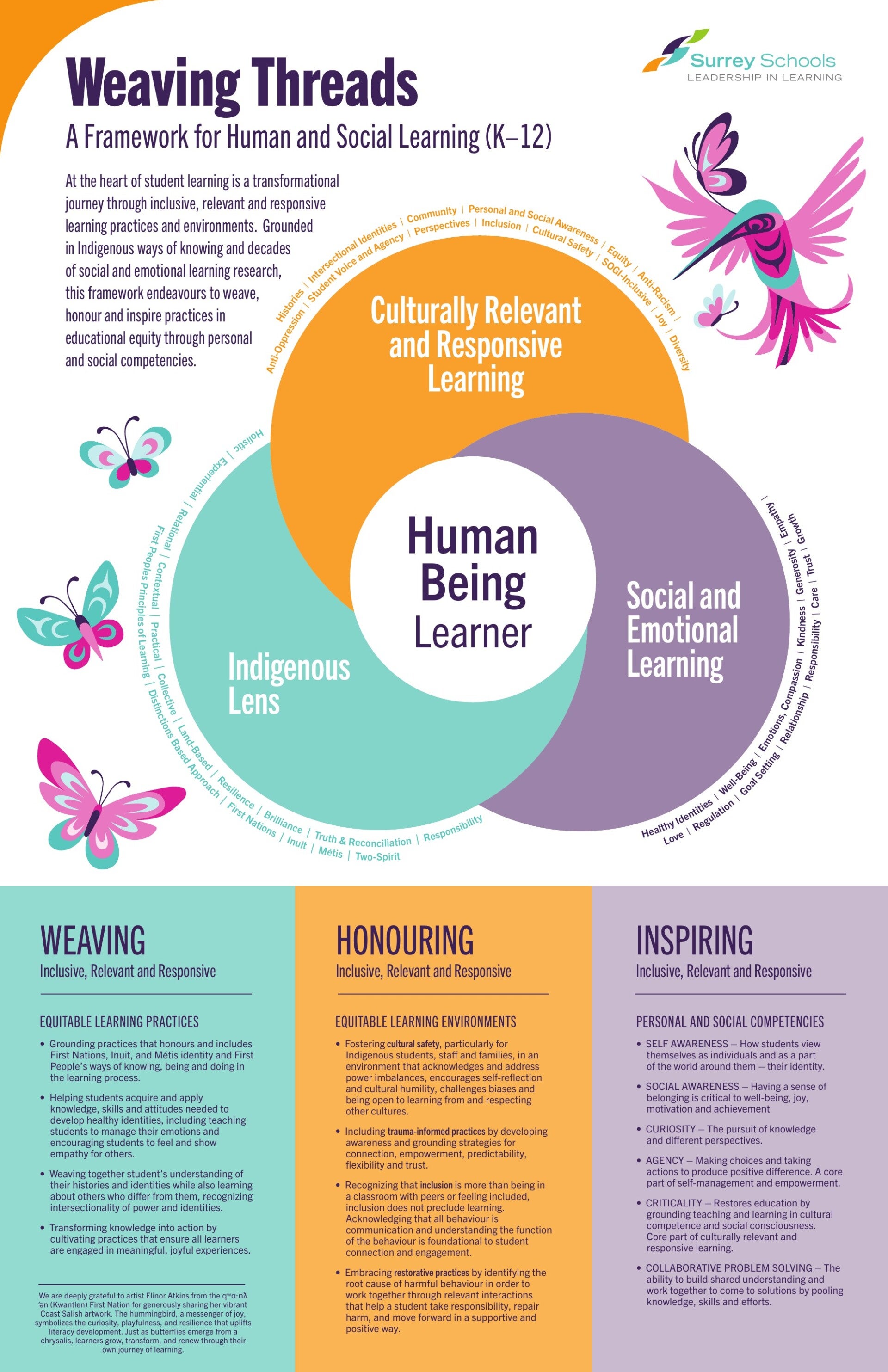
11. Weaving Threads
Teaching is iterative, relevant and responsive: educators revisit their practice, connect learning to students’ lives and adapt to diverse needs.
12. K–12 Literacy and Numeracy
Literacy and numeracy are foundational across subject areas and support communication, critical thinking and problem-solving.
13. Responding to Racism and Discrimination
Educators must recognize discrimination, question bias and stereotypes, support affected students and take action to create respectful and inclusive schools.
14. Allyship Framework
Allyship is an ongoing cycle of acknowledging injustice, learning with humility and acting against inequity.
ACKNOWLEDGE
Recognize historical and ongoing harms
LEARN
Be humble; listen and reflect
ACT
Show truth and courage
15. Connection to My Teaching Journey
As a future educator, I am learning that teaching is not only about sharing knowledge. It is about deep listening, careful observation, recognizing systemic barriers and creating equitable opportunities. I want students to feel valued, respected and included, and I want my actions to reflect my commitment to justice and reconciliation.
.