Inviting place: Connecting With The Land
Exploration A - reflects on stepping outside the traditional classroom walls to listen deeply to the land, trees, and the ancestral histories of British Columbia. Through field notes and reflective practice, this gallery documents an evolving commitment to relational, place-based pedagogy.
This collection of field sketches, reflective prompts, and land-inquiry notes captures the progression of this work. Each artifact represents an intentional step away from detached observation toward active listening, reciprocal dialogue, and meaningful contextual engagement.
This exploration helped me to learn more about the land and have a sense of understanding my connection to the land and my responsibilities.My key breakthrough was realising that learning does not begin inside four walls. By slowing down to connect with the land, talk with ancient trees, and honour the peoples who have stewarded these territories for millennia, I learned to view the environment not just as scenery, but as a living teacher.
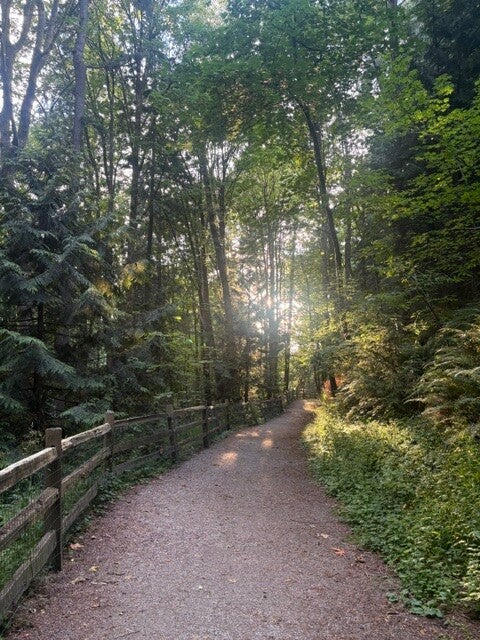
Inviting Place -Poem
I walk where many walked before,
Under the trees that quietly stand.
Their roots hold stories in the soil,
Their leaves reach gently for the sky.
The water carries memories along,
Some stories heard, some still unknown.
I pause, I listen, and I learn;
The Land can be a Teacher too.
And I will carry its stories with care.
Engaging with a Dialogue with the Land
Me: What stories do you hold beneath my feet?
Land: Stories older than the path you walk.
Me: Why do trees stand so quietly?
Land: They are listening, remembering and growing.
Me: What can I learn from you?
Land: Slow down, Notice and Listen !
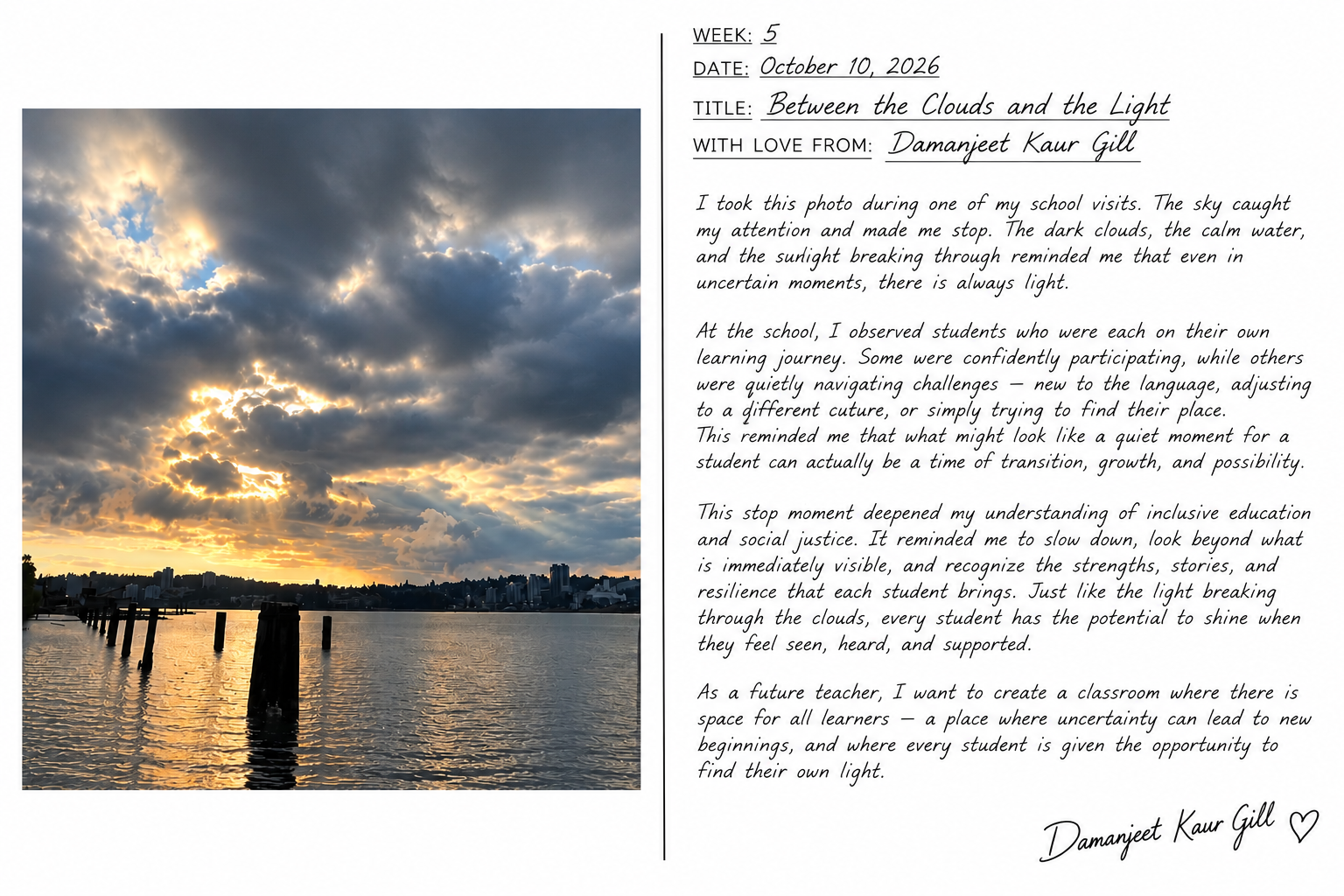
Postcard- Stop Moment
“Between the Clouds and the Light"
My postcard, “Between the Clouds and the Light,” connects to the Exploration A podcast because both remind us to slow down, observe carefully, and appreciate our surroundings.
I found a Stop Moment in watching sunlight break through dark clouds that reminded me that even in difficult moments, there is hope.
Just like clouds can hide sunlight, students may have hidden strengths and challenges that teachers need to recognize. That taught me how inclusion works.
The podcast taught me to respect the land and recognize nature as a source of learning.
As a future teacher, I want to look beyond what is visible, understand each student's unique journey, and create a classroom where everyone feels seen, heard, and supported. And also need to listen without judgement.
Connection with David Chang's ,
" A Land Based Eco Justice"
According to Chang, ecojustice teaches us that humans, plants, animals, land, and water are all interconnected. The words and everyday practices we use tell us how we treat nature. We should learn from the land and develop respect and responsibility towards it. We are part of nature, not its rulers, and nature is more than just a background.
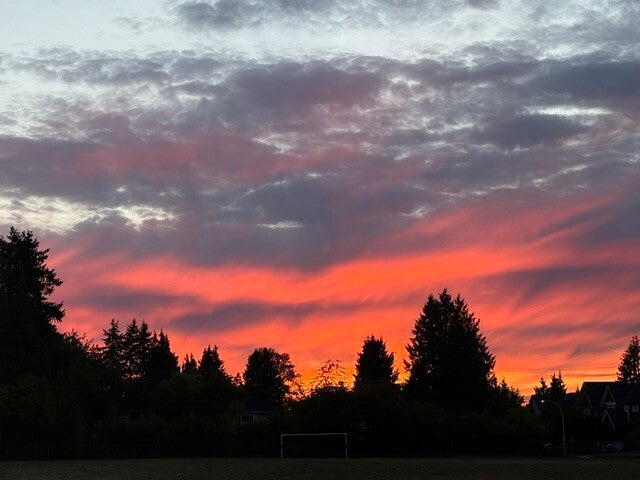
During my visit to my inviting place, I noticed a bright sunset, with trees appearing dark against the sky. The sunset and open field created a peaceful atmosphere. David Chang's ideas reminded me that paying attention to nature can help us build a stronger relationship with our everyday surroundings.
I also realized that the field is a shared space. People use it for recreation, but the trees remind me that humans are not the only ones who belong there. Birds, insects, and other living things also use this space. I wondered which birds, insects, and other living things live there when people are gone.
My responsibility towards the land is to leave no litter, respect the natural environment, and notice and learn more about the living things around me. This experience reminded me that we share the land with nature and have a responsibility to care for it.
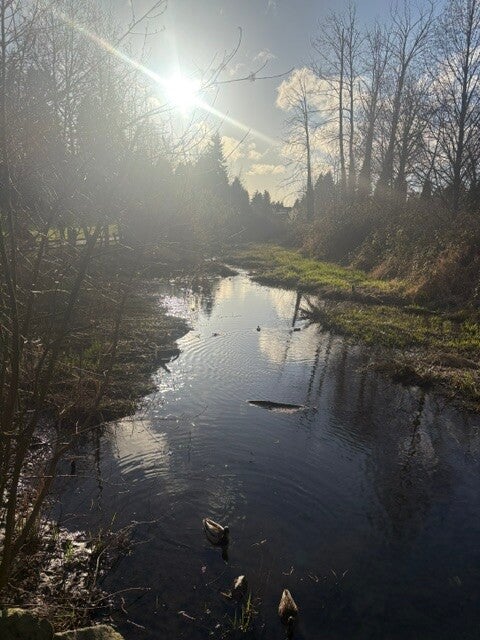
Listening to the Land and Building Connections- 'Land Speaking' by Dr. Jeannette Armstrong - weaves prose, poetry and story to explain the connection between land, Indigenous knowledge, and language.
After reading Land Speaking by Jeannette Armstrong, I realized that land is not just a physical place but a living teacher that communicates through sounds, movement, and nature. During my visit to Robson Ravine, I felt welcomed by the trees, fresh air, birds singing, and beautiful surroundings. Armstrong’s words reminded me that land teaches us throughout our lives. As a future educator, I believe learning should extend beyond the classroom. I want to encourage students to observe nature, listen carefully, ask questions, and build respectful relationships with the land.